Flow
Stop chasing, start discharging.
Patients who are medically ready to go home stay in hospital for days because equipment was not ordered, insurance has not approved, or no rehab bed is free. Flow finds each hospital’s worst bottlenecks, then puts AI agents on them, starting with medical equipment (DME) ordering.
The problem
Discharge delays are not one problem but a thousand paper cuts: equipment orders, insurance authorisations, post-acute beds, case management gaps. No existing tool tracks the whole discharge end to end.
What it does
Diagnose first
Every hospital loses time in different places. Flow starts by finding which bottlenecks cost the most days at that hospital.
DME agent
Orders and tracks medical equipment early, with documentation complete the first time, so a walker or oxygen does not keep a patient in bed an extra day.
One view of every discharge
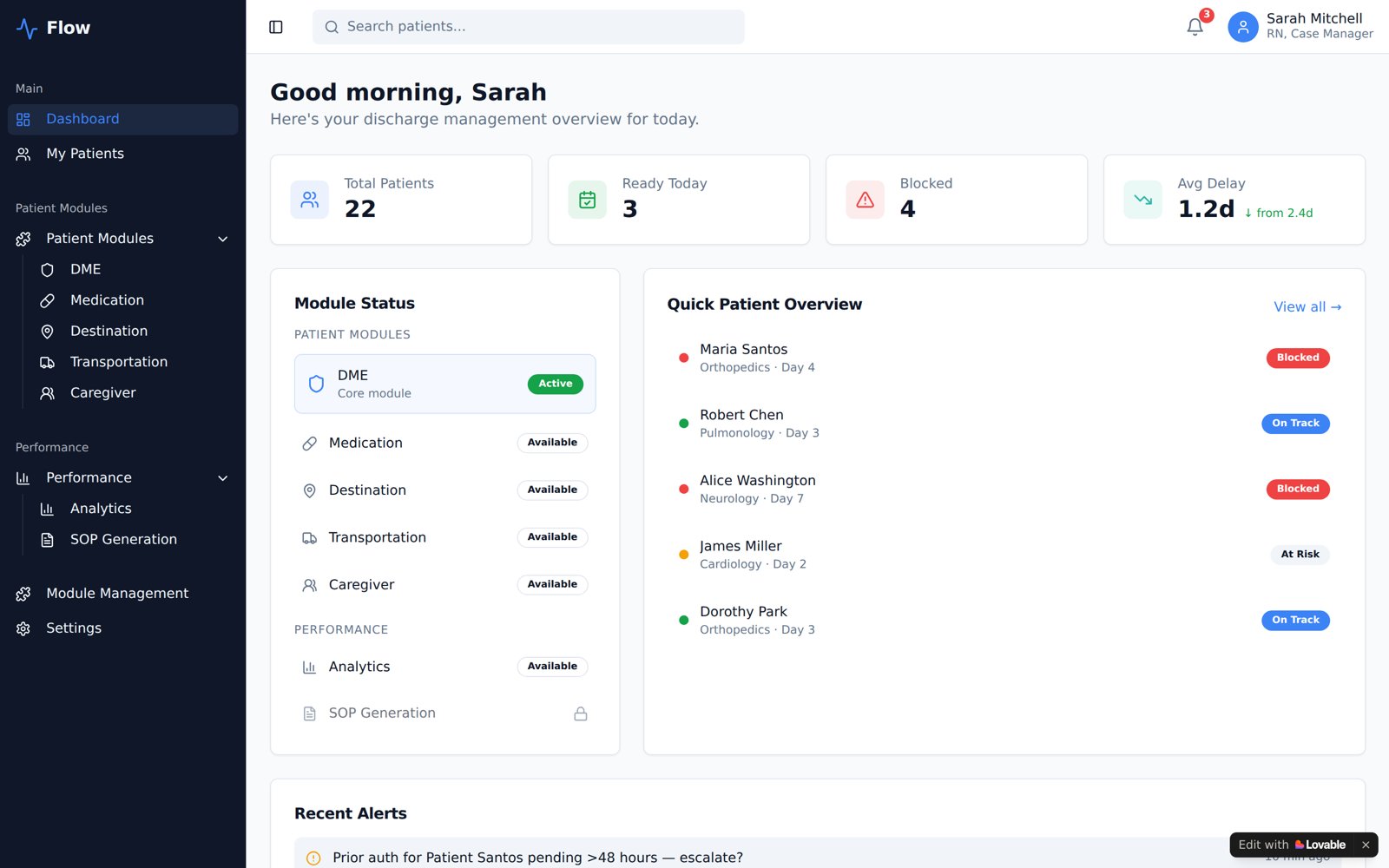
Case managers see who is blocked, at risk or ready, and why, with one click to chase the right person.
Modular
Start with one module, then add medication, destination, transport and caregiver as each proves itself.
What 20+ interviews taught us
- Discharge delays are not one problem but a thousand paper cuts. Physicians lose 2–5 hours a day to coordination across case management, equipment suppliers and nursing facilities, and no tool tracks it end to end.
- Hospital leaders put the cost at $3–5M a year and call it a top operational priority.
- Insurance authorisation is a leading driver of extra days. Case managers spend hours on the phone and fax with payers.
- Equipment causes about one in five delays: orders go in too late and are tracked by hand.
- Most denials are self-inflicted: missing fields, incomplete documentation, absent signatures. Medicare-complete paperwork satisfies every payer we checked, so one standard template fixes a controllable problem.
- Hospitals want to start with the one or two worst bottlenecks, not buy a new platform, and will pay for a pilot if it shows a measurable drop in length of stay.
Interviews with physicians, residents, advanced practice providers, case managers and hospital administrators, plus shadowing care teams, as part of Stanford’s Startup Garage.
Market and model
Enterprise tools like Qventus and LeanTaaS optimise capacity broadly, CareMaze offers a dashboard for the whole discharge, and prior-auth tools like Waystar sit on the payer side. Flow is the only one that diagnoses a hospital’s specific bottlenecks and then automates the top ones, from inside the hospital.
Go-to-market
- Pilot the DME module on high-discharge inpatient medicine services at one academic medical center.
- Measure denial rate, resubmissions and authorisation delay days over a 4–6 week pilot.
- Add an Epic SmartForm and auto-fill once the manual workflow is validated.
- Expand to skilled nursing authorisation, then to peer hospitals through warm introductions.
Context
- Startup Garage team project, Stanford GSB, Winter 2026
- Team of four GSB MBAs, including an MD/MBA, with a Stanford Medicine faculty sponsor
- My part: product, the prototype and the operating plan
- Prototype built in Lovable